Issue 1 · October 2026
Beyond the Five Senses
Olfaction as a Laboratory of Perception
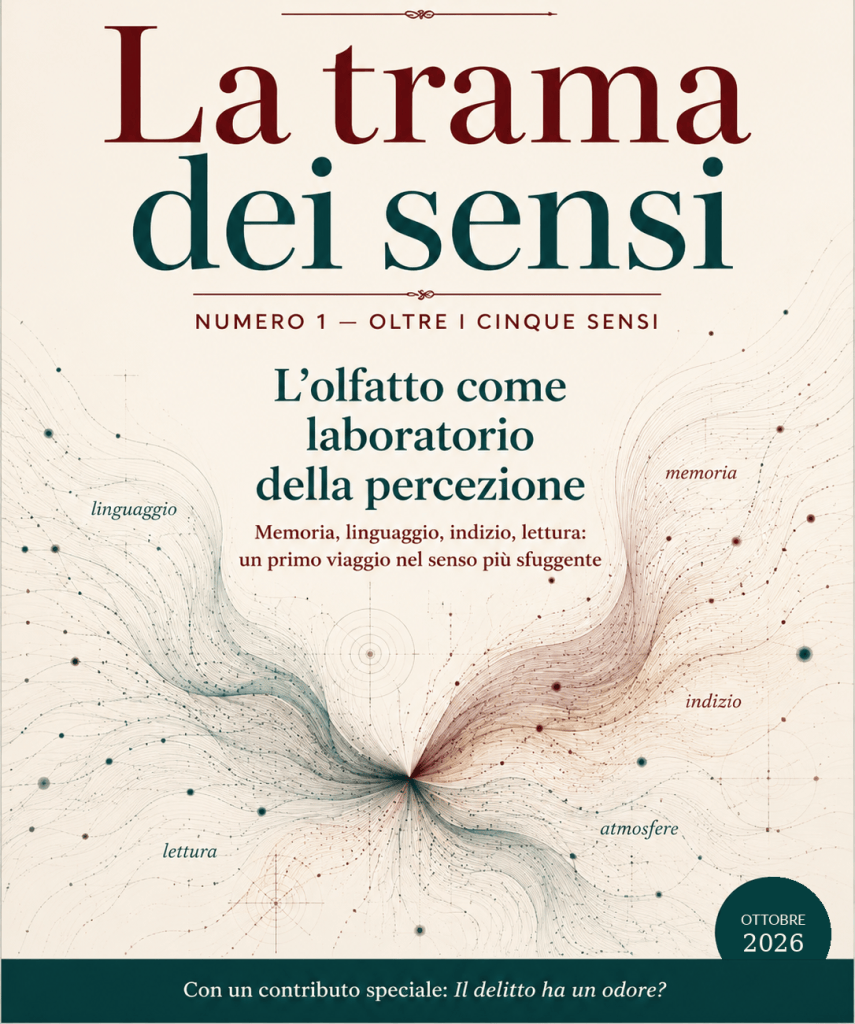
The first issue of La trama dei sensi explores how body, memory, language, and environment interact in the construction of perceptual experience. Rather than proposing yet another list of senses, it asks why perception cannot be reduced to five separate channels.
Why focus on olfaction?
Olfaction occupies a central place in this issue not because it exhausts sensory experience, but because it makes its complexity especially visible. Smells are difficult to name; they connect sensation with memory, shape judgments and behaviour, and enter reading as well as social life. Looking closely at olfaction therefore offers a particularly effective way of questioning the very idea of a separate sense.
Contents
Editorial · Perception Does Not Have Five Windows
The familiar five-sense model remains useful, but it can suggest a misleading picture of perception as a set of independent channels. From interoception and flavour to olfactory language and cultural hierarchies of the senses, this editorial introduces the central idea of the periodical: perception is better understood as a network of relations between organism and environment, sensation and expectation, experience and language.
Inside the Research · How Many Senses Do We Have? Perhaps We Are Asking the Wrong Question
Proprioception, balance, pain, temperature, and interoception all complicate the traditional count of five senses. This article examines different scientific criteria for defining a sense and shows why the answer changes depending on whether we classify receptors, neural pathways, functions, or conscious experience. The more revealing question may therefore be not how many senses we have, but what exactly we are counting.
Sensory Words · It’s on the Tip of My Nose
Why can we recognise a smell, judge it familiar or unpleasant, and still fail to name it? Recent experiments on lexical cues and free odour identification show that detecting a smell, recognising it, retrieving its source, and finding the corresponding word are related but distinct processes. The article also explores source-based naming, cross-linguistic differences, and the role of language in shaping olfactory categories.
Myths and Evidence · Are Smells Really Shortcuts to Memory?
Odours can evoke exceptionally vivid and emotional autobiographical memories, but vividness, confidence, and historical accuracy are not the same thing. Drawing on recent studies of familiarity, autobiographical recall, and olfactory spatial memory, this article separates several phenomena often grouped together under “olfactory memory.” Smell emerges less as a privileged shortcut to the past than as a powerful cue whose effectiveness depends on personal history and learned associations.
Signals · Books to Smell
Scratch-and-sniff books turn reading into an explicitly multisensory activity. A recent study of 334 olfactory books shows how smell is introduced differently across age groups: from explicit correspondences between object, word, and odour to narrative clues, humour, and social norms surrounding pleasant and unpleasant smells. The article asks whether such books might contribute to a still largely unexplored form of olfactory literacy.
One Word · Sentire: Between Body, Perception and Experience
The Italian verb sentire has no single English equivalent. Depending on context, it can mean to hear, smell, feel, sense, experience an emotion, or form an intuitive judgment. By following its grammatical and semantic extensions, the article shows how everyday Italian connects external perception, bodily states, emotions, social relations, and consciousness within a single remarkably flexible word.
Special Feature · Does Crime Have a Smell?
Crime fiction is often imagined as a strongly visual genre, yet smell can function as evidence, social judgment, atmosphere, and a threshold between physical reality and psychological disturbance. Drawing on novels by Augusto De Angelis, Giorgio Scerbanenco, and Donato Carrisi, this essay follows a historical shift from odour as material clue and social marker to bodily experience of the city and, finally, to an unsettling connection between memory, fear, and the mind.

